
Manufacturing capabilities
Aluminum & bronze sand casting
A Baltimore nonferrous foundry casting A356, A357, C355, 319 and 535 Almag aluminum alloys, plus aluminum, silicon and manganese bronze. Conventional tooling and 3-D printed sand molds support your component geometry.
A connected process
Define
Review alloy, geometry, quantity and acceptance criteria.
Form
Produce pattern tooling or print sand molds and cores.
Cast & finish
Pour, clean, heat treat and machine as specified.
From molten metal to a finished casting
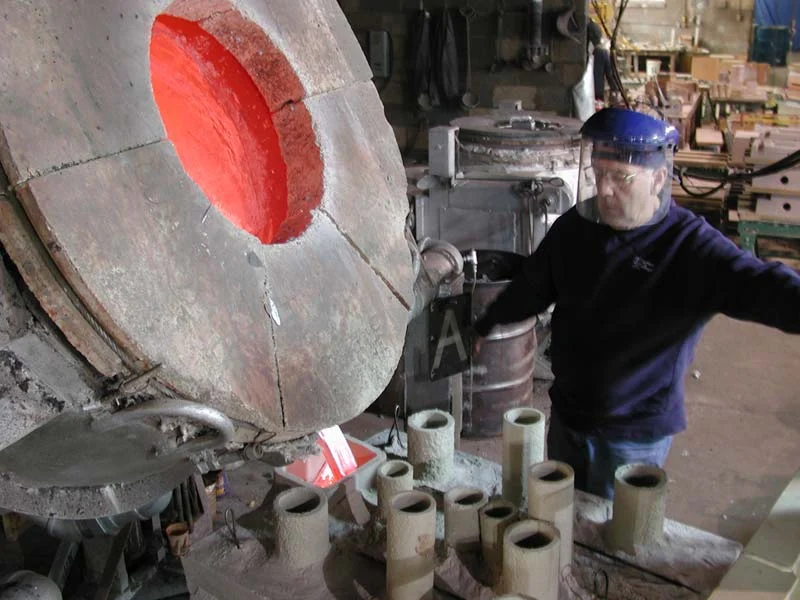
Metal is melted and poured into a mold made from bound sand. After cooling, the sand mold is broken away, and the gating and risers are removed for remelting. Our team grinds and cleans each casting before the next manufacturing stage.
Connected to the next process
In-house heat treatment, CNC machining and inspection keep casting connected to the requirements of the finished component. Blasting options include aluminum oxide, glass beads and shot blast.
Technical overview
View alloy & specification reference
Browse specifications by material family, or download the complete table.
| Aluminum alloys | A356, A357, C355, 319 and 535 (Almag) |
|---|---|
| Bronze alloys | 415 aluminum bronze, 500 silicon bronze and 421 manganese bronze |
| Mold routes | Conventional pattern tooling and 3-D printed sand molds and cores |
| Finishing | Gate and riser removal, grinding and abrasive blasting |
| Next operations | Heat treatment, machining, dimensional inspection and applicable nondestructive testing |
Equipment capacities describe the published system configuration; usable part size and achievable tolerance depend on the component and process.